Learn
Climate change:
What’s genetics got to do with it?
Genetic technologies are being developed to contribute to solving the climate crises.
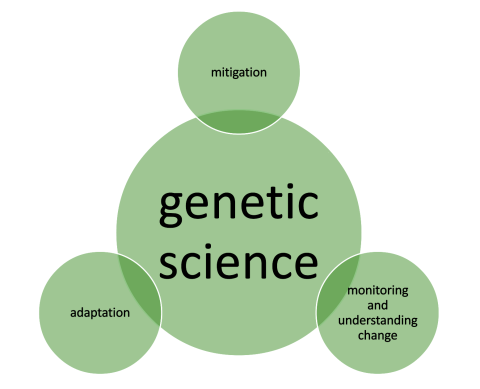
The technological approaches fall into three broad action areas:
- Mitigation (examples: carbon capture)
- Adaptation (examples: climate resilient crops, preventing spread of infectious disease)
- Monitoring and understanding change (examples: genomic changes, biodiversity changes)
Genetics is one of many contributors to these three action areas. Genetics alone will not solve the climate crises.
Are any of these genetic technologies already in the world?
Yes
Field tests of trees designed to grow faster (and by growing faster capture carbon dioxide more quickly) are happening now. Other technologies (including agricultural crops and microorganisms are in various stages of development and testing).
Haven’t heard about any of this?
You’re not alone and we’re here to change that together.
Reach out and let us know if you would like to connect to learn more. [link to Act landing page]
We’re learning too.
Here’s what our team has been reading/watching/listening to this month (posts ≠ endorsement of content). [Link to blog like subpage of Learn section]
We want to learn from you.
Let us know what questions and worries you have about this topic. [Link to Connect landing page]
Tell us in 6-8 words what the climate crises mean to you. [Link to Share your thoughts subpage of Act section]
What do we mean by climate crises?
Have you noticed the weather has changed in your lifetime or do you hear elders refer to changes they’ve observed?
Climate crises refer to the myriad of problems that result from human-caused changes to Earth’s atmosphere that outpace the natural ability of life on our planet to adapt.
More frequent, severe, and/or erratic weather patterns and natural disasters (hurricanes, flooding, wildfires, extreme and unseasonable high and low temperatures, etc.) are negatively impacting humans and other life on our planet. These changes to the physical world will continue to worsen if we are unable to change our atmosphere by reducing carbon dioxide, methane, and other gases that cause overall warming on our planet at a faster rate than natural cycles.
The impacts on the physical world create changes in our social world (refugees, mass migration events, conflict, etc.), so we include these as part of the climate crises.
We use ‘climate crises’ to help us remember that there are myriad issues at play every time we speak about climate change and how to repair the planet and sustain life going forward.
What are some areas of life and society that are already being particularly impacted by the climate crises?
Here’s just a few impacted areas that we Americans say we care deeply about
Agriculture
National and international security
Public health and infectious disease
Sports and outdoor activities
Travel and tourism
What can I do?
Your actions matter. If you are reading this, you are getting informed. If you then talk to at least one other person about something you have learned, you are making a difference. If you regularly connect with people in your life and work to talk about how the climate crises are impacting the folks in your life, the difference you are making is multiplied. Here are some ideas for other individual actions you can take [link to action resource list]. Ultimately, collective action is needed to address the scale and interrelatedness of the climate crises, so talk to your local, state, and national policy makers and let them know you want them to prioritize policy solutions to the climate crises.
How we’re working with terms
Genetics – We include any and all science that alters any aspect of the genetic materials in living organisms (DNA, RNA, epigenetic modifications)
Technology – The application of knowledge in all forms, including but not limited to science-generated knowledge, for achieving practical purposes
Climate crises – The multitudes of problems that can be linked with evidence to human-influenced global climate change
Other science fields that include genetic technologies (key search terms):
- Agricultural biology
- Bioengineering
- Biosecurity
- Biotechnology
- Synthetic biology
- Systems biology